How Green Coffee Travels | Green Coffee Supplier in Europe
Posted by Admin
How Does Green Coffee Travel? From Origin to Your Roastery. It's late June in Cerrado Mineiro, and the dry mill is running flat out. Bags of natural coffee are being filled, sealed, labelled and stacked high. One of those lots has already been cupped and approved by us, and sold to a roastery that counts on us as its green coffee supplier in Europe. On paper, the coffee is ready. Its last stop before the roastery will be one of our warehouses in Europe, to hold it for our roasters.
It won't reach the roaster for weeks yet. And that has nothing to do with the coffee.
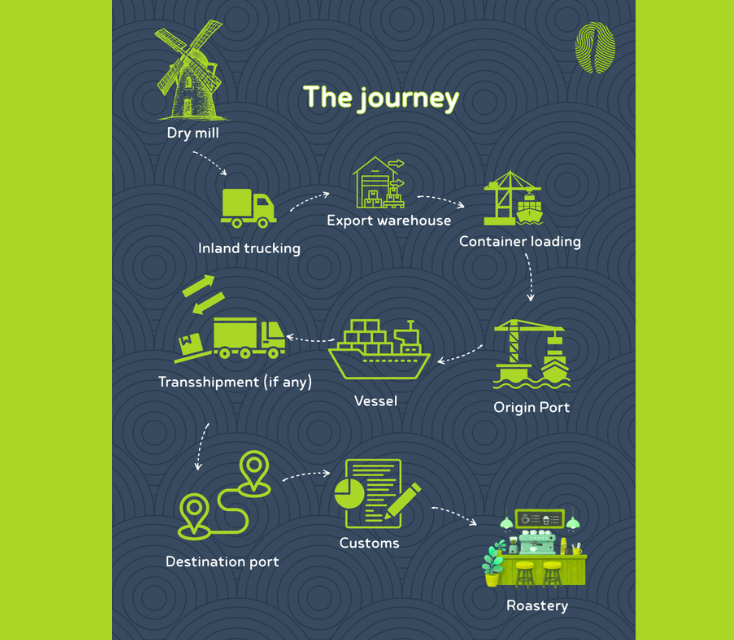
You know the route already: Dry mill → Inland trucking → Export warehouse → Container loading → Port and terminal → Vessel → Transshipment port (if any) → Destination port → Customs clearance → Warehouse → Roastery
Most roasters could sketch it on the back of a napkin. What's harder to see from the roastery floor is how many separate companies a single lot passes through, each working to its own calendar. For a specialty roaster lining up a single-origin release, or a commercial roaster keeping a blend on the shelves all year, those handovers decide when green coffee beans actually land.
So let's follow that imaginary container, the way we watch it as your green coffee importer, and see what each step means for your green coffee supply. At Attesa Coffee, being a dependable green coffee supplier in Europe starts right here, with knowing every one of those handovers by name.
At origin: the mill, the road and the quay
Our lot leaves the mill on a truck early on a Tuesday. Ahead of it is the long drive to Santos, the port that handled 78.7% of Brazil's coffee shipments in 2025. It isn't alone on that road. In peak season it's one truck among thousands.
That kind of concentration is normal at origin. Colombia sends around 60% of its coffee exports through Buenaventura. When most of a country's green coffee beans funnel through one or two ports, the roads and terminals around them set the tempo for the whole shipping season, and for the green coffee supply that depends on it.
At the exporter's warehouse, the lot is weighed again and the paperwork stacks up: certificate of origin, plant health certificate, and commercial invoice. A pre-shipment sample flew ahead by courier days ago. Back in Europe, our QC team is already slurping it while the bags are still on the pallet. As your green coffee importer, we want to know how a lot tastes long before it lands.
Then the exporter needs a box. Empty containers are released by the shipping line, and how many are on hand depends on trade flows that reach far beyond coffee. For us as your green coffee supplier in Europe, this is where planning really begins: matching approved lots with trucks, containers and vessel space, so the coffee reaches the quay in time for its sailing.
Each origin also runs on its own harvest clock, so arrivals reach us as your green coffee importer in Europe in waves rather than a steady stream. A Brazilian season and a Central American season land at very different points in the year.
On the water: bookings, rolls and transshipment
The loaded container rolls through the terminal gates at Santos and settles into the yard to wait for its booked vessel. If that vessel fills up, or its rotation shifts, the box could move to the next sailing. Every shipper of every cargo lives with this, and as your green coffee supplier in Europe, we plan around it.
Eventually our container sails, though not always straight to its final port. Very few big ocean services call at every European port, so a box bound for a coffee importer in Europe like us often heads for a hub first. It might go to Antwerp or Rotterdam, where it’s lifted off, waits for its connection and is loaded onto a smaller feeder vessel for the last leg to the port closest to our warehouse. Another handover, another timetable.
The planned route can also change once the journey is under way. On paper and in practice, it often looks like this:
Planned: Origin port → Destination port
Actual: Origin port → Antwerp → Destination port, or Origin port → Rotterdam → Destination port
Each stop at a hub means the box is lifted onto another vessel, which adds one more handover to the chain.
Routes like this are perfectly normal, and they can change the transit time from the same origin quite a bit. It’s worth talking routing through with us, your green coffee importer, when you sign the contract, rather than when the coffee is already at sea.
It’s also why we look at a shipment one stage at a time. Which vessel, which hub, which feeder: those three answers tell you far more about your green coffee supply than a single date in an email.
Landing in Europe
The feeder ties up at its destination port on a grey morning. The coffee is here, but it isn't part of anyone's green coffee supply just yet.
The container still has to be discharged, cleared through customs, trucked to one of our European warehouses, opened, unloaded and weighed. Arrival samples go to the cupping table and are checked against the pre-shipment approval before we, as your green coffee importer, release the bags.
In our story, the container is headed for our Warsaw warehouse. Wherever coffee lands, the last step tends to look the same: green coffee beans are stored, checked and released to roasters as they need them, whether that’s a few bags of a microlot or several containers for a blend. This is the point where your green coffee supplier in Europe hands the coffee over to you.
From arrival to roastery
Every handover between the dry mill and the warehouse shapes when green coffee beans are actually ready to roast. For us, that makes the journey part of your plan, not a detail in the background. As your green coffee importer, we keep you in the loop as the coffee moves, so releases and production runs can be lined up with confidence. And as your green coffee supplier in Europe, we help shape a green coffee supply that fits the way you roast, whether that’s a seasonal single origin or a year-round blend.
Planning your green coffee supply around the journey
Specialty and commercial roasters plan in different ways, but both get more from their green coffee supply when the route is part of the plan rather than an afterthought.
If you roast specialty
Plan seasonal and single-origin releases around an arrival window, not a single date, and leave yourself a cushion before launch.
Secure priority lots of specialty green coffee early with us as your green coffee supplier in Europe, so they have time to move through origin.
Keep some landed spot green coffee in reserve for gaps on the menu.
If you roast at commercial scale
Book wholesale green coffee for core blend components forward, and stagger shipments through the year to keep your green coffee supply steady.
Spread key profiles across origins and routes, so no single port carries the whole programme.
Agree stock cover with us as your green coffee importer, so inventory in our warehouses, including Warsaw, bridges the gap between shipments.
Either way
Ask for updates at loading, sailing, transshipment and arrival, not only the final ETA.
Talk to us, your green coffee supplier in Europe, and map out harvest and shipping calendars across your origins together.
How we follow every shipment
At Attesa Coffee, we don't stop watching a lot once it leaves the farm. As a green coffee importer and green coffee supplier in Europe, we follow each stage: the truck, the container, the port, the booking, the voyage, any transshipment and the final delivery to one of our warehouses. When a schedule shifts, our clients hear about it from us as early as we can tell them.
For roasters who work with us as their European green coffee supplier, that means the details behind the date: which vessel, which route, when the coffee will be available, and arrival samples once it lands. It turns a long green coffee supply chain into something you can build a roasting calendar around, whether you buy a few bags of a microlot or several containers a season.
Work with us - your dependable green coffee supplier in Europe
Somewhere in Europe, our imaginary roaster is tipping that natural Cerrado into the hopper. Between the dry mill and that moment sat a long line of trucks, terminals, ships, brokers and the team at our warehouse, each doing their part.
That’s really what a dependable green coffee supply comes down to: a lot of people each doing one job well, and someone keeping an eye on the whole chain. As your green coffee importer, that’s the part we care about most, for specialty and commercial roasters alike.
Whether you're planning next season's single-origin releases or securing the backbone of a year-round blend, we can help you:
Contract specialty and commercial green coffee forward and plan shipments around your roasting calendar
Balance forward contracts with spot coffee for urgent needs
Follow every shipment from origin to our warehouses, with updates at each key stage
Map your green coffee sourcing, origins and arrival windows for the year ahead
Planning for the coming season? Talk to our team about your green coffee supply, ask for our current offer list of green coffee beans, or find out where your coffee is right now. Get in touch with Attesa Coffee, your dependable green coffee supplier in Europe, today.
Curious where your next coffee could come from? Explore all our origins and discover the green coffee beans we’re bringing in this season, from the farms and regions we know best.