Planning Through El Niño: Green Coffee Origins, Quality and Prices for 2027.
Key takeaways: El Niño and green coffee in 2027
- The 2026-27 El Niño is likely the strongest on record. NOAA gives an 83% chance that October-December 2026 will exceed every El Niño since 1950, with strong conditions lasting into March 2027.
- Supply starts from a strong position. Brazil has just harvested its largest crop ever, Vietnam’s current robusta harvest looks steady, and Colombia could rebound in 2027.
- The key risk is Vietnamese robusta. Rainfall in Vietnam’s Central Highlands is forecast 20-40% below normal, with water scarcity peaking in early 2027.
- Central America is already feeling it. Honduras and Guatemala forecast 7% and 10% lower 2026/27 output, and their premiums are at three-year highs.
- Prices will stay lively, but not extreme. ICE-certified arabica stocks are at their lowest since 1999, yet arabica remains well below its October 2025 peak.
- Expect more variable green coffee quality: smaller beans and more defects from drought origins, and drying challenges where harvest rain is heavy, such as Ethiopia, Kenya and Peru.
- Over the next three to six months, we’ll be working with our roasters to review forward cover, secure key origins and plan backup origins and blend substitutions.
What is El Niño, and why does its timing matter for 2027?
Think of El Niño as the Pacific Ocean running a fever. Every few years, surface water in the central and eastern tropical Pacific warms up, and that extra heat changes where the tropics get their rain. Some coffee regions dry out and others get soaked. It usually builds through the northern autumn, peaks around New Year and fades by the following summer.
This year’s event is a big one. The World Meteorological Organization declared El Niño on 2 June 2026, and it’s already the strongest ever recorded for the time of year. By mid-October the Niño 3.4 reading had reached +3.3°C, compared with peaks of around +2.4 to +2.6°C in the 1997–98 and 2015–16 “super” El Niños. NOAA expects strong to very strong conditions to stick around until March 2027 (El Niño Live, NOAA CPC data).
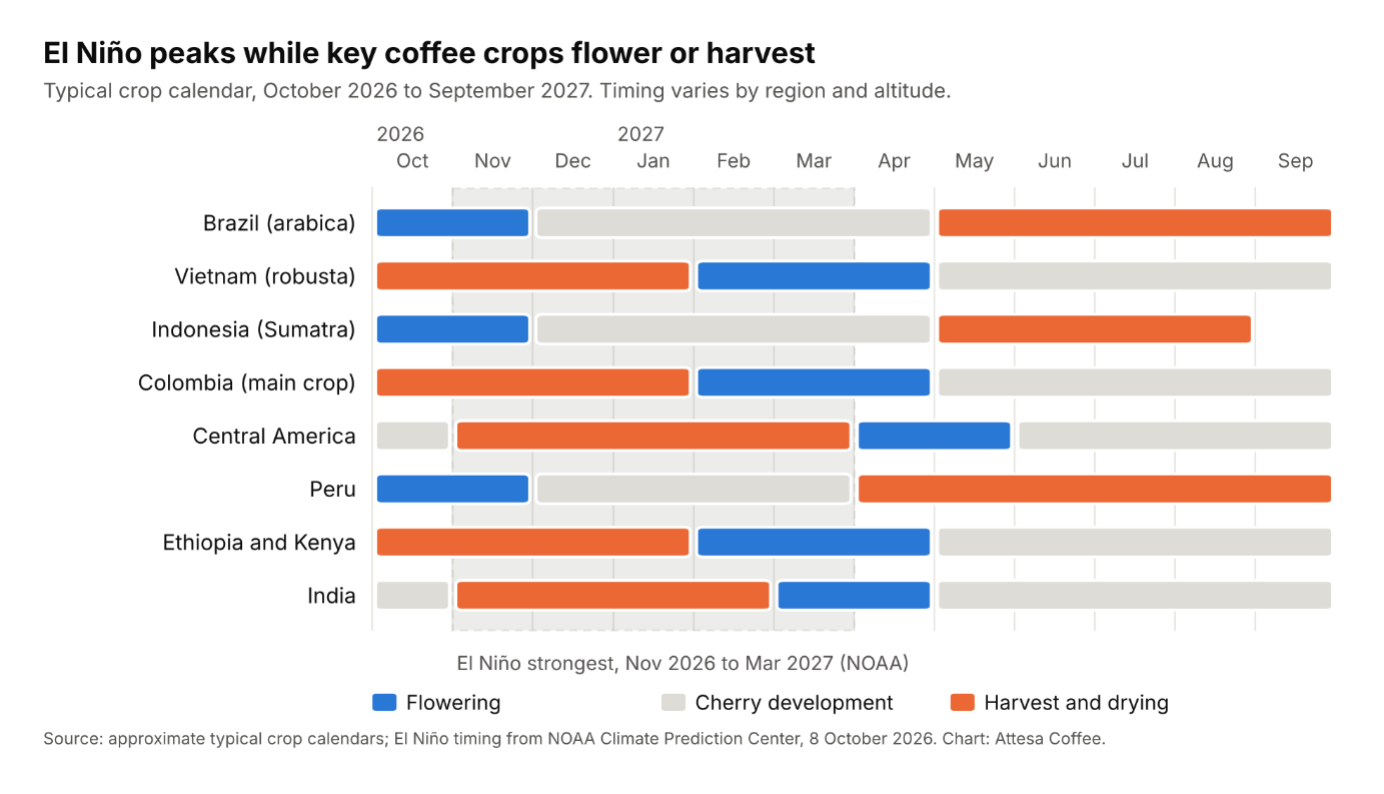
For coffee, when the weather hits matters as much as how hard. Trees need rain at the right moment to flower evenly, steady moisture to fill the cherry, and dry weather for picking and drying. This El Niño will be at its strongest between November and March, which lines up with some critical stages at origin.
- Brazil is flowering now, so the next few weeks of heat and rain will decide how much of next year’s crop sets.
- Vietnam has just started picking its 2026/27 robusta, but the real test comes in February to April, when growers irrigate to bring on flowering for 2027/28.
- Colombia, Central America, Ethiopia and Kenya are harvesting and drying, and at this stage a dry spell or heavy rain tends to hurt quality more than volume.
- India starts picking in November and then depends on its February to April blossom showers for next year’s crop.
All of this plays out slowly, and prices can stay firm for up to a year after a strong event. That gives roasters in Europe time to plan ahead instead of scrambling later.
As Nishit Tanna, Founder at Attesa Coffee, puts it: “El Niño shows us where the risks are. The harvest shows us what we’ll actually get. Our job is to watch both and keep our roasters a step ahead.”
How is El Niño affecting each green coffee origin?
El Niño doesn’t hit every origin the same way, and that’s actually good news for buyers. When one region tightens, another often has coffee to offer. Here’s how things look from where we sit as of late October 2026, along with the opportunity we see in each origin.
Brazil: a record crop to build on
Brazil has just harvested its biggest crop ever: 66.7 million bags by Conab’s count and 71.9 million by the USDA’s. El Niño has been kind so far, with September rain in Guaxupé, Minas Gerais, nearly three times the norm, giving next year’s flowering a healthy start.
The flowers still need to set fruit between November and January, and 2027 is an “off” year in arabica’s two-year cycle. Brazil’s instant coffee association warns a super El Niño could cut output by up to a fifth (Global Coffee Report), though growers are better equipped than in past events. With a record crop on the market, now is a good time to secure your Brazilian base coffees.
Vietnam: a steady harvest now, so plan ahead for 2027/28
This is the origin we’re watching most closely. The current Robusta harvest looks steady at around 32 million bags, but Central Highlands rainfall is expected to run 20 to 40% below normal, with water shortages peaking in early 2027. Robusta bought from this crop avoids that risk, so early cover makes sense for espresso and commercial blends.
Colombia: a softer 2026, with promise for 2027
Colombia’s 2026 output is expected to fall 8% to 12.5 million bags, but drier weather is keeping leaf rust in check and could set trees up for a better 2027 harvest. If the dryness stays moderate, Colombia should be a dependable source of washed arabica.
Central America: tighter, but great coffee is still out there
El Niño is most visible here. Honduras is forecast down 7% and Guatemala down 10%, with regional premiums near three-year highs. Coffee’s deep roots help it cope with drought, and higher-altitude farms handle heat better. Book your favourite lots early, with Colombia or Peru as alternatives.
Other origins to watch
Indonesia’s Robusta regions have swung from too much rain to too little, so Indian and Brazilian Robusta are worth sampling as back-ups. Peru faces its own coastal El Niño, making well-run cooperatives the safest choice. In East Africa, heavy rain during harvest will favour stations with covered drying. In India, Karnataka output could drop 15 to 20%, so early-season Robusta and Monsooned Malabar are worth securing.
How will El Niño affect green coffee quality?
Expect more variation this season. A crop can look big on paper and still offer fewer lots that meet your quality standards. In Brazil, out-of-season rain during harvest made cherries fall and hurt bean quality in some arabica regions. A five-year study of 60 Robusta farms found that a dry late growing season pushed the chance of below-average bean size above 80%, while heavy rain and warm nights at harvest pushed the chance of above-average defects above 75%.
Here’s what to watch for:
What should European green coffee buyers watch?
These are the signals on our own dashboard, and we’ll keep clients updated on each through our regular origin briefings.
- ICE certified stocks in New York, Antwerp and Hamburg. A steady rebuild would ease pressure on arabica.
- Vietnam’s rainfall and reservoir levels from December to April, the biggest factor for robusta.
- Brazil’s fruit set, with the first real read on the 2027 crop in January and February.
- Origin differentials, especially Central America, Colombia and East Africa, which can rise even when futures fall.
- EUR/USD. Coffee trades in dollars, so currency swings can shift your landed cost by several percent.
- EUDR readiness. The EU Deforestation Regulation applies to large and medium operators from 30 December 2026 and to micro and small operators from 30 June 2027. Coffee without proper geolocation data will be harder to sell in Europe, shrinking eligible supply.
What should coffee roasters do now to prepare for 2027?
The next three to six months are your window. Vietnam’s dry season, Brazil’s fruit set and prices will all become clearer, and roasters who act early will have the widest choice of lots and more room to negotiate.
For specialty coffee roasters
- Lock in key origins early. Commit to 2026/27 volumes for the coffees that anchor your menu rather than waiting for spot offers.
- Have a plan B. Line up a similar-cupping alternative for each signature coffee, such as Peru or Colombia for a washed Central American.
- Check samples thoroughly. Cup pre-shipment and arrival samples from the same lot, and check moisture, screen size and defects too.
- Spread the risk. Several smaller lots from different producers protect your menu if one farm has a tough year.
- Share the story. Explaining why a coffee has changed builds customer loyalty.
For commercial roasters and high-volume buyers
- Extend forward cover, especially on Robusta and Central American washed arabica.
- Mix fixed and PTBF contracts so you get some budget certainty while fixing futures in stages.
- Pre-approve blend substitutions, such as Brazilian, Indian or Ugandan Robusta alongside Vietnamese.
- Use stock already in Europe. Our EU warehouse stock at Attesa Coffee can cover gaps at short notice.
- Get EUDR-ready before 30 December 2026, as compliant coffee may get harder to find.
- Budget for a range. Arabica rose almost 50% in a month this summer, so one number won’t cut it.
How Attesa Coffee can help you plan for 2027
El Niño will make 2027 a more interesting year to buy green coffee, but with the right partner it doesn’t have to be a harder one. As a green coffee supplier in Europe, Attesa Coffee works directly with producers across 15 origins, keeps stock in our EU warehouse and speaks with our partners every day, so we can spot changes early and offer alternatives before gaps appear.
Here’s how we help roasters stay ahead:
- Flexible contracts: We’ll review your forward cover and help you choose between fixed price, PTBF or staged fixing.
- Fast samples: from current and upcoming crops, plus alternatives for origins under pressure.
- EU warehouse stock: ready for prompt delivery when you need to fill a gap.
- EUDR-ready traceability: with the geolocation paperwork you’ll need from 30 December 2026.
- Practical origin updates: on weather, harvests and prices from the origins you buy.
Ready to plan your 2027 green coffee? Talk to our team about forward contracts, request samples from current crops, or sign up for our origin updates. We’ll help you turn El Niño from a risk into a plan. Join our newsletter for early word on new harvests, fresh arrivals, and offers - everything you need to plan ahead, straight to your inbox. Subscribe Now!
Reach us at — hello@attesa.co
Explore our origins →
Discover the green coffee beans we’re bringing in this season, sourced from farms and regions we know well.
Current - Spot Offer List
FYI
About Attesa Coffee
Attesa Coffee is a green coffee importer based in the Netherlands, specializing in responsibly sourced and fully traceable specialty coffee. Our team, spread across Europe, South America, and Asia, brings deep expertise and cultural diversity to our operations.
We work directly with reliable farmers and producers at origin, building long-term, transparent relationships. Our coffees are evaluated both at origin and in the Netherlands to ensure consistent quality.
Frequently asked questions
Will El Niño push green coffee prices up in 2027?
It raises the risk. Arabica prices are already volatile because exchange stocks are at their lowest since 1999, and robusta is exposed to drought in Vietnam’s Central Highlands from early 2027. The outcome depends on rainfall over the next six months.
Which coffee origins are most affected by the 2026–27 El Niño?
Vietnam, Indonesia, Central America and India face drought and heat. East Africa and Peru face heavy rain during harvest and flowering. Brazil and Colombia have so far seen mixed effects.
How does El Niño affect green coffee quality?
Drought tends to produce smaller, lighter beans and more defects. Heavy rain at harvest increases drying problems, mould risk and uneven cups.
Why are coffee prices high after a record Brazil harvest?
Much of the new Brazilian crop does not meet exchange grade, certified stocks are very low, and the market is pricing El Niño risk to the 2027 crops in Brazil, Vietnam and Central America.
What should European roasters do now?
Review forward cover, secure key origins early, line up backup origins and blend substitutions, consider PTBF contracts, use EU warehouse stock as a buffer, and confirm EUDR documentation before 30 December 2026.
How long will the 2026–27 El Niño last?
NOAA expects strong to very strong conditions through January–March 2027. Its effects on coffee last longer, because weather during flowering in late 2026 and early 2027 shapes harvests picked in mid-2027 and the 2027/28 season.
Is El Niño good or bad for coffee?
It depends on the origin. El Niño usually brings drought to Vietnam, Indonesia, India and Central America, and heavy rain to East Africa and Peru. In parts of Colombia, moderate dryness can reduce leaf rust, but severe drought cuts yields and bean size.
When will green coffee prices come down?
No one can predict this precisely. Prices could ease as Brazil’s record crop reaches the market, ICE-certified stocks rebuild and if Vietnam’s dry season proves milder than forecast. Arabica is already well below its October 2025 peak, and buying in stages helps roasters benefit from any dips.
Does the EUDR affect green coffee supply in 2027?
Yes. From 30 December 2026, large and medium operators placing coffee on the EU market must prove it is deforestation-free and traceable to the plot. Coffee without geolocation data will be harder to sell in Europe, narrowing the eligible supply.
Where can European roasters source green coffee during El Niño?
Work with a green coffee supplier in Europe that has direct producer relationships across several origins and stock already landed in the EU. Attesa Coffee supplies specialty and commercial roasters from 15 origins